The call center is no longer just a room full of phones and headsets. Today, the most successful customer service operations are powered by AI 콜센터 technology that delivers faster, smarter, and more personalized experiences at scale. By exploring AI-powered support for omnichannel engagement, businesses can ensure seamless customer journeys across voice, chat, email, and social media.
Instead of choosing between lower costs and better service, AI makes it possible to achieve both. Automated voicebots and chatbots resolve routine inquiries instantly, while AI-powered tools guide human agents to deliver outstanding support with less effort and stress.
This guide explains what an AI call center is, how it works, and the concrete benefits it can bring to your business, your agents, and your customers.
The rise of the AI call center has transformed how businesses connect with customers. Companies no longer rely solely on traditional phone lines. Instead, intelligent systems analyze customer behavior, predict needs, and route inquiries to the right agent instantly. By integrating advanced technology, brands can improve customer satisfaction, reduce wait times, and boost overall efficiency.
Some organizations are leveraging emerging computing technologies for AI systems to process large volumes of customer data efficiently. These advanced solutions help call centers scale operations while maintaining high performance. In parallel, others are adopting high-performance computing tools to enhance the speed and accuracy of AI-driven analytics, allowing agents to respond faster and more effectively.
Marketing strategies also benefit from AI insights. For example, online marketing for customers shows how AI call centers can personalize campaigns by analyzing customer interactions across multiple channels. Likewise, practical marketing strategies from Marketing Runners highlight how combining automated chat support with human guidance improves both engagement and conversion rates.
Financial institutions see clear advantages as well. Resources from Top Financial Resources for business support illustrate how AI call center technology can streamline client interactions, reduce errors, and ensure secure handling of sensitive financial information. Predictive analytics allows agents to anticipate questions and provide more relevant solutions, improving both efficiency and trust.
Modern AI call centers are no longer just about answering calls—they create seamless, personalized experiences across multiple channels. By integrating technology-driven insights, marketing intelligence, and financial tools, businesses can deliver smarter support, optimize agent performance, and foster long-term customer loyalty.
Top 10 AI Call Center Solutions to Transform Your Customer Support
The AI call center landscape is growing rapidly, offering businesses advanced tools to improve efficiency, personalize customer interactions, and optimize agent performance. Here are the top 10 AI contact center solutions to consider:
1. Bright Pattern: Comprehensive AI Contact Center Solutions
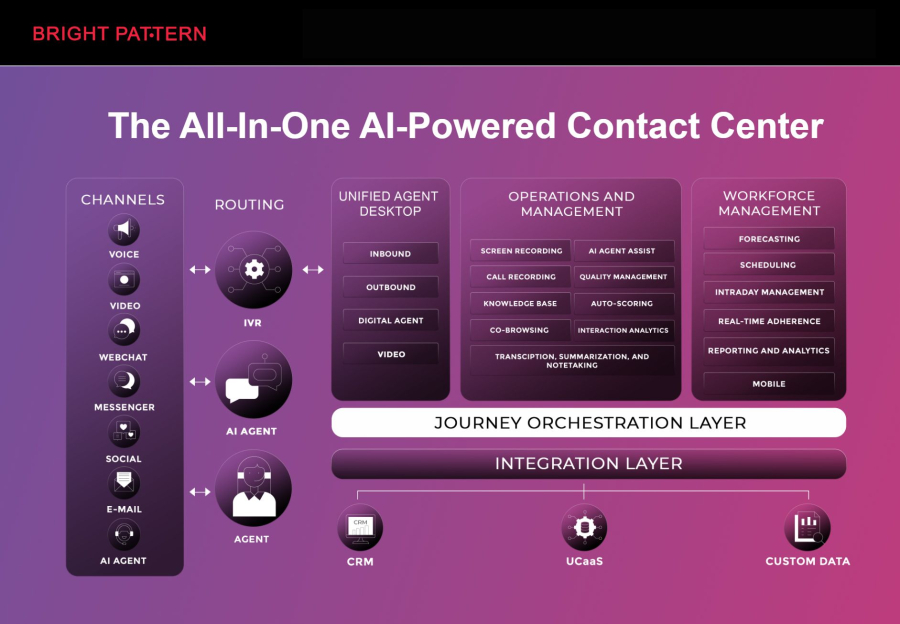
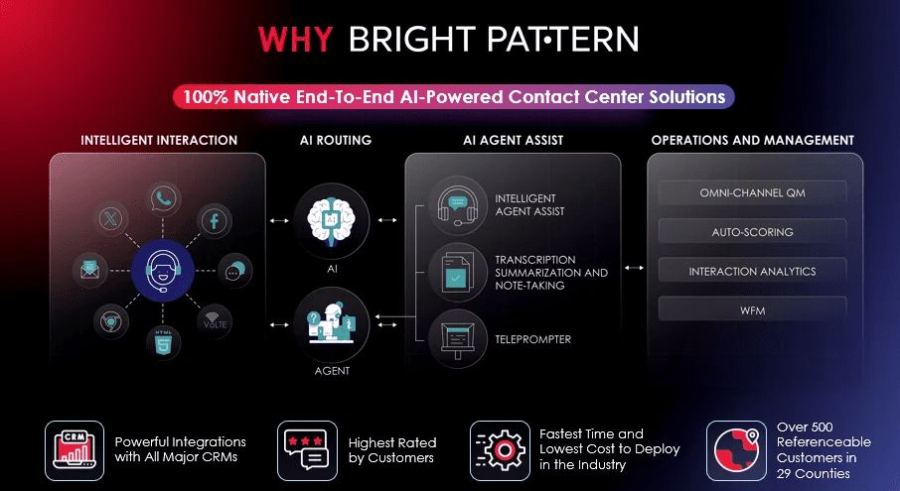
Bright Pattern leads the industry in delivering AI call center technology that enables seamless customer experiences across multiple channels. Their platform is designed to integrate AI tools with human agents, improving response times and satisfaction rates.
Key features include:
- Omnichannel routing for voice, chat, email, and social media
- AI-assisted agent guidance for faster resolutions
- Automated chatbots and voicebots for routine inquiries
- Real-time analytics to monitor agent performance and customer trends
- Easy integration with CRM and business software for a unified support experience
Bright Pattern is ideal for businesses looking to scale customer service operations while maintaining a high level of personalization and efficiency. Their AI-driven tools help call centers reduce costs, minimize agent stress, and deliver smarter, faster support to every customer.
2. Genesys Cloud CX
Genesys Cloud CX offers an AI-powered contact center platform with omnichannel support, predictive routing, and conversational AI bots that streamline customer interactions and optimize agent workflows.
3. NICE CXone
NICE CXone provides a comprehensive suite of AI contact center solutions, including virtual agents, speech analytics, and real-time coaching to enhance customer engagement and operational efficiency.
4. Five9 Intelligent Cloud Contact Center
Five9 leverages AI to automate routine tasks, route calls intelligently, and assist agents with predictive insights, making it easier to deliver consistent, high-quality customer support.
5. Talkdesk CX Cloud
Talkdesk combines AI with cloud contact center technology to enable proactive customer engagement, AI-driven workflows, and data-driven decision-making for more effective service.
6. RingCentral Contact Center
RingCentral’s AI contact center solutions focus on omnichannel engagement, workforce optimization, and automation to improve agent productivity and customer satisfaction.
7. 8x8 Contact Center
8x8 integrates AI tools into its contact center platform to enhance call routing, provide real-time agent guidance, and enable predictive analytics for smarter support decisions.
8. Amazon Connect
Amazon Connect is a cloud-based AI contact center solution that provides natural language chatbots, machine learning insights, and scalable automation for improved customer experiences.
9. Twilio Flex
Twilio Flex allows businesses to customize their AI call center with programmable workflows, automated responses, and integrations with third-party applications for a flexible support solution.
10. Vonage Contact Center
Vonage uses AI-powered tools to optimize routing, automate routine interactions, and deliver detailed reporting, helping agents provide faster and more effective customer support
What Is an AI Call Center?
AnAI call centeris a customer support operation that uses artificial intelligence to handle, assist, or optimize customer interactions across voice and digital channels. Instead of relying solely on human agents, AI call centers combine:
- Virtual agentsthat answer calls or messages, understand natural language, and resolve many issues automatically.
- Agent-assist toolsthat listen to or analyze conversations in real time and provide suggestions, knowledge, or next best actions to human agents.
- Analytics and automationengines that monitor performance, extract insights, and trigger workflows in the background.
The result is ahybrid modelwhere AI handles repetitive work and humans focus on complex, high-value, and emotionally sensitive interactions.
How an AI Call Center Works
Behind the scenes, several AI capabilities come together to transform the way calls and messages are handled:
- Automatic call routing: AI analyzes caller intent, history, and context to route each interaction to the best resource, whether that is a virtual agent, a specific skill group, or a priority queue.
- Natural language understanding: Modern AI understands phrases, accents, and free-form questions, allowing customers to speak or type in their own words rather than using rigid menu options.
- Knowledge and workflow automation: The system pulls answers from FAQs, knowledge bases, CRMs, and back-office systems, and can trigger actions such as resetting passwords or updating orders.
- Real-time agent assistance: While an agent is talking or chatting, AI can suggest replies, surface relevant articles, summarize policies, or flag compliance risks.
- Analytics and quality monitoring: Conversations are transcribed, categorized, and analyzed, producing insights about customer needs, product issues, and agent performance.
Together, these capabilities turn a traditional call center into a data-driven, continuously improving customer engagement hub.
Why Businesses Are Moving to AI-Powered Call Centers
Organizations across industries are adopting AI call center solutions because they deliver measurable benefits on multiple fronts: customer experience, operational efficiency, and employee satisfaction.
1. 24/7 Availability Without 24/7 Staffing
Customers now expect support to be available whenever they need it. With AI:
- Virtual agentscan handle calls and messages around the clock, including evenings, weekends, and holidays.
- Global coveragebecomes easier, since AI does not need breaks, shifts, or overtime pay.
- Peak load handlingis smoother, as virtual agents can scale quickly during high-demand periods like product launches or seasonal spikes.
The result is shorter wait times and greater convenience for customers, without dramatically increasing staffing costs.
2. Faster Response and Resolution Times
AI call centers reduce the friction customers feel when they need help. AI can:
- Answer immediately, eliminating long hold times for routine questions.
- Authenticate and verifycallers using information they provide, reducing time spent on manual security checks.
- Surface account dataand past interactions instantly to give agents a complete picture before they even say hello.
- Automate simple actionslike checking order status, updating contact details, or scheduling appointments without waiting for an agent.
These improvements directly impact key metrics such asAverage Handle Time (AHT)andFirst Contact Resolution (FCR), leading to happier customers and lower operational costs.
3. Higher First Contact Resolution Rates
Customers value getting their issue solved the first time they reach out. AI supports this by:
- Automatically answering common questions correctly and consistently.
- Guiding agents with recommended solutions based on similar past cases.
- Accessing multiple back-end systems at once to provide a full picture of the customer situation.
- Detecting when a conversation is at risk and recommending escalation or callbacks proactively.
This reduces the need for follow-up calls and transfers, improving customer satisfaction scores and reducing strain on the contact center.
4. Better Customer Experience and Personalization
AI call centers excel at recognizing patterns and tailoring interactions. With AI, you can:
- Recognize returning customersand personalize greetings based on history and preferences.
- Use context-aware responsesthat take into account current orders, previous tickets, or account status.
- Offer proactive support, such as reaching out when a shipment is delayed or a payment fails, before customers contact you.
- Maintain consistent service qualityacross voice, chat, email, and social channels.
Personalization makes customers feel valued and understood, increasing loyalty and lifetime value.
5. Reduced Operating Costs and Increased Scalability
AI does not replace the human touch; it amplifies it. But it does significantly improve the cost structure of your support operations:
- Self-servicevia virtual agents reduces the volume of calls that require a live agent.
- Agent productivityimproves because AI handles repetitive tasks like typing notes, searching for information, or filling in forms.
- Training timedrops as AI tools guide new agents with real-time prompts and best practices.
- Scalabilityimproves, allowing you to handle growth without linearly increasing headcount.
This combination enables organizations to provide higher-quality service at a lower cost per contact.
6. Happier, More Effective Agents
AI call centers do not just benefit customers; they also make work more manageable and rewarding for agents. Agents gain:
- Less repetitive work, since routine questions are handled by AI.
- On-screen guidancethat helps them respond accurately, even in complex situations.
- Automatic call summariesand note-taking that reduce after-call work.
- Coaching insightsfrom AI-powered quality monitoring that highlights strengths and improvement areas.
All of this helps reduce burnout and turnover, while empowering agents to focus on higher-value conversations where human empathy and judgement make the biggest difference.
Key Capabilities of an AI Call Center
While AI call center platforms vary, leading solutions typically offer a common set of powerful capabilities. Understanding them helps you identify what your organization needs most.
Natural Language Understanding for Voice and Chat
At the heart of any AI call center is the ability to understand what customers are saying or typing. Natural Language Understanding, or NLU, enables:
- Free-form questions instead of rigid numeric menus.
- Recognition of synonyms and variations in how customers phrase their issues.
- Intent detection, such as"I want to change my flight"or"My internet is down".
- Entity extraction, such as names, dates, account numbers, or product IDs.
This allows AI to respond in a natural, human-like way and guide the conversation smoothly.
Omnichannel Support
An AI call center is typically not limited to phone calls. It also supports:
- Chaton your website or mobile app.
- Messagingchannels such as SMS or in-app messages.
- Email, where AI can categorize, route, and draft suggested replies.
- Social channels, where the same AI logic can respond to direct messages and comments.
This gives customers a seamless experience across channels, with AI and human agents sharing context and history.
Intelligent Routing and Queuing
Routing is no longer just about choosing the next available agent. With AI:
- Customers can be routed based on predicted intent, language, sentiment, or value.
- High-priority customers or critical issues can automatically move to the front of the queue.
- Virtual agents can triage and gather information before handing off to a human, so the agent is fully briefed.
- Business rules can be combined with predictive models to optimize outcomes such as sales conversion or retention.
Real-Time Agent Assist
Agent-assist tools are a major advantage of AI call centers. These tools can:
- Listen to calls or read chat messages in real time.
- Highlight key information from the customer profile or knowledge base.
- Suggest replies, next steps, or offers based on the conversation.
- Alert supervisors when a call requires intervention.
Instead of searching through multiple systems or asking colleagues for help, agents get the right information at the right time, improving both quality and speed.
Analytics, Reporting, and Quality Monitoring
Every interaction in an AI call center becomes a data point. Platforms typically provide:
- Transcripts and summariesof voice and chat interactions.
- Sentiment analysisto understand customer emotions.
- Topic and trend detectionshowing why customers are contacting you.
- Performance dashboardswith metrics by channel, team, and agent.
- Automated quality scoringbased on script adherence, disclosures, and soft skills.
These insights help leaders continuously refine scripts, training, products, and processes.
AI Call Center vs Traditional Call Center
The contrasts between traditional and AI-augmented call centers are significant. The table below highlights some of the most important differences.
| Aspect | Traditional Call Center | AI Call Center |
| Availability | Limited by staffing hours and shift patterns. | Virtual agents offer 24/7 coverage; humans focus on core hours and complex cases. |
| Scalability | Scaling requires hiring, training, and scheduling more agents. | AI scales instantly to handle volume spikes, with targeted human support. |
| Customer Experience | Highly dependent on individual agent skills and availability. | Consistent, fast responses with personalization powered by data. |
| Agent Workload | High volume of repetitive inquiries and manual tasks. | Routine work offloaded to AI; agents focus on complex, value-added conversations. |
| Insights and Reporting | Limited sampling of calls; manual QA and analysis. | Automatic analysis of all interactions with real-time dashboards and trends. |
| Cost Structure | Costs rise roughly in line with call volumes and headcount. | Greater share of volume handled by AI, lowering cost per interaction. |
High-Impact Use Cases for AI Call Centers
AI can support almost any industry or process that involves customer interactions. Some of the most impactful use cases include:
Customer Service and Technical Support
- Answering common questions about orders, billing, or account access.
- Providing step-by-step troubleshooting for devices or software.
- Resetting passwords and unlocking accounts securely.
- Proactively notifying customers about outages, updates, or maintenance windows.
Sales and Cross-Sell
- Qualifying inbound leads before passing them to a human sales representative.
- Recommending products or upgrades based on customer history and behavior.
- Supporting agents with real-time prompts about offers, bundles, or promotions.
- Following up with interested prospects via automated outbound calls or messages.
Collections and Billing Support
- Sending reminders about upcoming or overdue payments.
- Handling simple billing questions and clarifications.
- Collecting payments through secure automated flows.
- Escalating sensitive or complex cases to skilled human agents.
Appointment Management and Reservations
- Scheduling, rescheduling, and canceling appointments.
- Sending automated reminders and confirmations.
- Managing waitlists and filling last-minute openings.
- Coordinating multi-step appointments that require preparation or documentation.
Internal Service Desks
AI call centers are not only for external customers. Internal support functions also benefit, including:
- IT help desksfor password resets, device issues, and software access.
- HR service centersfor benefits questions, policy clarifications, and onboarding.
- Facilities and operationsfor incident reporting and status updates.
Measuring the Success of Your AI Call Center
A well-run AI call center is guided by clear metrics. Organizations typically track a mix of customer, operational, and financial indicators, such as:
- Customer Satisfaction (CSAT)andNet Promoter Score (NPS).
- First Contact Resolution (FCR)for both AI and human-assisted interactions.
- Average Handle Time (AHT)andAverage Speed of Answer (ASA).
- Self-service containment rate, or the percentage of inquiries fully handled by AI.
- Agent productivity, including interactions per hour and time spent on after-call work.
- Cost per contactand overall support cost as a percentage of revenue.
By monitoring these metrics and tying them to business goals such as retention, revenue, and satisfaction, you can continuously refine your AI call center strategy.
Implementing an AI Call Center: Practical Steps
Launching an AI call center is not a one-time project; it is a journey of continuous improvement. However, you can start strong by following a structured approach.
1. Define Clear Objectives
Begin by clarifying what you want to achieve. Common goals include:
- Reducing average wait times and improving service levels.
- Increasing self-service for common inquiries.
- Boosting agent productivity and reducing burnout.
- Improving customer satisfaction and loyalty.
Clear objectives help prioritize use cases and guide technology and design decisions.
2. Map Customer Journeys and Contact Drivers
Analyze why customers contact you and what their ideal experience looks like. For each major journey:
- Identify frequent questions and pain points.
- Decide which steps can be handled by AI and which require a human.
- Design smooth handoffs between virtual and human agents.
- Consider emotional moments where human empathy is essential.
3. Start with High-Value, Low-Complexity Use Cases
Quick wins build momentum. Many organizations start with:
- Account balance inquiries, order status checks, and simple updates.
- Appointment management and basic billing questions.
- Automatic authentication and data collection before connecting to an agent.
These use cases deliver measurable benefits quickly, while providing valuable data to refine your AI models.
4. Integrate with Your Existing Systems
For AI to be truly effective, it must connect to the systems that hold customer and product data, such as:
- Customer Relationship Management platforms.
- Order management and billing systems.
- Knowledge bases and content repositories.
- Authentication and identity management tools.
Deep integration allows AI to do more than simply respond; it can take actions and resolve issues end to end.
5. Design Conversational Experiences Carefully
Even the most advanced AI depends on thoughtful design. Invest time in:
- Writing clear prompts, flows, and error messages.
- Setting the right tone of voice for your brand and audience.
- Providing escape routes, so customers can easily reach a human when needed.
- Testing with real users and iterating based on feedback.
6. Train, Support, and Involve Your Agents
Agents are critical partners in any AI transformation. To maximize adoption and impact:
- Explain how AI will support them, not replace them.
- Train them on using agent-assist tools effectively.
- Gather their feedback to improve virtual agent scripts and flows.
- Recognize and reward agents who embrace the new tools and share best practices.
7. Monitor, Learn, and Improve Continuously
AI call centers become more powerful over time as they learn from data. Establish a rhythm of:
- Reviewing analytics and call transcripts.
- Updating intents, responses, and routing logic.
- Refining knowledge articles and training materials.
- Experimenting with new use cases and measuring results.
Addressing Common Questions About AI Call Centers
As organizations evaluate AI call centers, several questions tend to arise. Addressing them directly helps build confidence and alignment.
Will AI Replace Human Agents?
AI is most effective when itcomplementshuman agents, not replaces them. Virtual agents excel at handling repetitive, predictable tasks, freeing people to focus on complex, sensitive, and relationship-driven conversations. In practice, many organizations see their agents move into higher-value roles, such as specialized support, retention, or consultative sales.
Can AI Really Understand Our Customers?
Modern AI has made enormous progress in understanding natural language, accents, and informal speech. However, the best results come when AI is trained on your specific terminology, products, and customer scenarios. Continuous tuning based on real interactions ensures that your virtual agents and agent-assist tools become more accurate and helpful over time.
Is an AI Call Center Only for Large Enterprises?
While large enterprises were early adopters, AI call center technology is increasingly accessible to organizations of all sizes. Cloud-based platforms, flexible pricing, and prebuilt use cases make it possible for smaller businesses to start with targeted automation and scale as they see results.
The Strategic Advantage of an AI Call Center
An AI call center is more than a technology upgrade; it is a strategic advantage. Businesses that embrace AI-powered customer engagement can:
- Deliver fast, consistent, and personalized service at any time of day.
- Operate more efficiently and reinvest savings into growth and innovation.
- Empower agents with tools that make them more effective and engaged.
- Turn customer interactions into a rich source of insight for the entire organization.
As customer expectations continue to rise, AI call centers offer a powerful way to delight customers, energize teams, and build a resilient, future-ready support operation.
By starting with clear goals, focusing on high-impact use cases, and involving your agents every step of the way, you can unlock the full potential of AI and transform your call center into a true engine of customer satisfaction and business growth
